
Sensex ends below 19,000 mark after 3 months.

Prime Minister Narendra Modi on Saturday hard sold his government's reforms spanning from manufacturing to taxation to labour, saying they have changed the world perception about the country from 'why India' to 'why not India' and went on to quote record foreign investment during the pandemic as a testimony to that. Speaking at industry association Assocham's Foundation Week event, Modi also said agriculture reforms brought by his government six months back have started benefiting farmers. The reforms in the last six years have influenced in changing the sentiment of the industry from 'why India' to 'why not India' in investing.

Pegging the cost of the covid-19 lockdown at USD 120 billion (approximately Rs 9 lakh crores) or 4 per cent of the GDP, analysts on Wednesday sharply cut their growth estimates and stressed on the need to announce an economic package. The Reserve Bank of India (RBI), which is scheduled to announce its first bi-monthly policy review on April 3, is set to deliver a deep rate cuts and it should also be assumed that the fiscal deficit targets will be breached, analysts said.

After more than two decades and three attempts, the government has finally sold its flagship national carrier Air India, and it is deja vu for Maharaja as it returned home to its founding father the Tata group. Jehangir Ratanji Dadabhoy (JRD) Tata founded the airline in 1932 and named it Tata Airlines. In 1946, the aviation division of Tata Sons was listed as Air India, and in 1948, the Air India International was launched with flights to Europe. The international service was among the first public-private partnerships in India, with the government holding 49 per cent, the Tatas keeping 25 per cent and the public owning the rest. In 1953, Air India was nationalised and for the next over four decades it remained the prized possession for India controlling the majority of the domestic airspace.

'Equities are likely to be range-bound with a downward bias for the remaining part of the year.'

'Tax dodging through tax havens is one of the ways multinational corporations and the super-rich in India are using to evade taxes.'

Bouts of month-end dollar demand from banks and importers hit the rupee

It is after the GST Network tallies invoice details with shipping bills that the refund claims can be processed. So, the refund could be delayed by over a month.

Jewelers also want import duty on gold to be reduced from the current 10 per cent to at least 5 per cent.

Market experts believe the retreat is because of uncertainty.
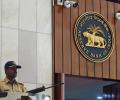
The balance sheet of the Reserve Bank plays a critical role in the functioning of the country's economy.

Steps such as safeguard duty in the works to plug the route

'Nationalism built on divisiveness cannot strengthen the country, or help the economy improve its performance,' points out T N Ninan.

India on Thursday ruled out a Free Trade Agreement with China, until 'domestic distortions' like high taxes and poor infrastructure are corrected.

The government's second round of stimulus will spur consumer spending in the near term but support to economic growth will be minimal, Moody's Investors Service said.

'One way to deal with these is to address these quickly and have rapid reaction teams in New Delhi, the state capitals and wherever possible.'

The rupee is being driven into a vicious circle.

There was fresh selling of the American currency by banks and exporters

Finance Minister Nirmala Sitharaman will present her second Budget a little more than a month from now. Like any other FM, Sitharaman will depend on her team of bureaucrats and advisors to frame and present the Budget.

'Good investment opportunities should not be missed.'

The report cautioned that low capacity utilisation and stressed balance sheets of banks and businesses will prevent a strong investment revival in the short term.
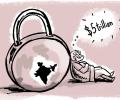
'There is a fiscal crisis building up, which might become apparent when the Finance Commission presents its report,' warns T N Ninan.

Karnataka, Andhra Pradesh, Tamil Nadu, Rajasthan, Maharashtra, Bihar, Uttar Pradesh, Madhya Pradesh, and Gujarat account for 85 per cent of India's maize production.
Under pressure from the United States and the European Union, which have dragged it to the World Trade Organisation over high duties on wines and spirits

'The Budget will have to be substantially re-cast as soon as a new government takes charge after the elections.' 'Both revenue and expenditure numbers will have to be trimmed -- and then may better reflect the deceleration of economic activity caused by slowing consumption trends,' points out T N Ninan.
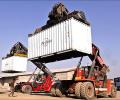
Commerce ministry monitoring remedial measures to promote exports in key markets.
A faltering economy may have led to a re-think on economic strategy. And Mr Modi might think he is politically strong enough to take some risks. But there could be a minefield ahead, observes T N Ninan.
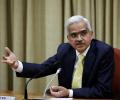
The Reserve Bank remains laser-focused to bring back retail inflation to 4 per cent over a period of time in a non-disruptive manner, Governor Shaktikanta Das stressed while voting for status quo in interest rates, as per minutes of the October policy meeting released on Friday. The central bank has been mandated by the government to ensure the Consumer Price Index (CPI) based inflation is at 4 per cent, with a band of 2 per cent on either side. The retail inflation, which was above 6 per cent during May and June, has started moving down and stood at 4.35 per cent in September.
The rupee had ended 5 paise lower at 67.49 on Monday.

Markets suffered after other Asian indices closed in the red, tracking record-breaking losses at the Wall Street overnight.

The FPI holding in India's top 100 companies, which are part of the Nifty 100 index, declined to 24.23 per cent on average at the end of March this year, from a high of 27.5 per cent at the end of March 2021. This is the lowest FPI holdings in India's top listed companies in at least three years. A general sell-off by FPIs has weighed on stock prices and the benchmark S&P BSE Sensex is down 8.5 per cent, from its 52-week high made in October 2021. Most analysts expect FPI flows to remain weak in FY23 as well, given rising bond yields in the US and an expected earnings slowdown in India due to high inflation and commodity prices.

'Investors should reduce cash gradually and look for value investing.'

The 50-share NSE Nifty was trading lower by 24 points.

The economy could grow at 6-6.5 per cent this fiscal year (2019-20 or FY20), said Chief Economic Advisor Krishnamurthy Subramanian, revising his earlier estimate of 7 per cent in the Economic Survey. In an interaction with Arup Roychoudhury, he said supply-side measures, including corporation tax cuts, will boost consumption and demand, and non-tax revenue may make up for shortfall in tax revenues.

"India's economy is projected to sustain a 7.6 per cent growth rate in both fiscal years 2016-17 and 2017-18," says the year-end update of the flagship report Economic and Social Survey for Asia and the Pacific 2016 of the United Nations Economic and Social Commission for Asia and the Pacific (ESCAP).

Early GST rollout to help create more jobs, boost output, says IMF.

India is a market for low-priced cars with low running costs. The global majors don't have models that fit the bill; only Maruti and Hyundai have successful entry-level models, observes T N Ninan.

Businesses are still taking time to adjust in the new tax regime, which would weigh on growth rates for the financial year closing today.

The Confederation of All India Traders has approached Union Home Minister Amit Shah, Union Health Minister Harsh Vardhan, Delhi Lieutenant Governor Anil Baijal, and Chief Minister Arvind Kejriwal, and urged them to shut markets in Delhi.

Domestic markets are also aided by a rally in the global markets with US market surging to record high and a firming trend at other Asian bourses.
